
- Types of Licenses and Permitted Types of Activity
- Who Should Apply For the Crypto License in El Salvador
- Main El Salvador Crypto License Requirements
- El Salvador Crypto License Factsheet
- Advantages
- Disadvantages
- Licensing Process (Step-by-Step)
- Maintenance and Ongoing Requirements
- Renewal, Suspension and Revocation
- Regulatory Updates (2023–2026)
- Why El Salvador Attracts Cryptocurrency Business
- Official Sources & Primary Legislation (El Salvador)
Obtaining crypto licenses, white label consulting,
ICO/STO, supporting NFT marketplaces, drafting policies
for crypto projects, DAOs, and gamify projects
El Salvador created one of the clearest legal systems for cryptocurrency business.
In 2023, the Legislative Assembly of the country adopted two key laws — Regulations for Digital Asset Service Providers and the Digital Assets Issuance Law. They defined transparent rules for token issuance, activities of issuers, service providers, and other market participants.
Control over compliance with these rules is carried out by the National Digital Assets Commission (CNAD). Its main mission is to ensure execution of regulatory requirements, support the development of innovations, and create a safe environment for working with digital assets.
CNAD maintains open registers of digital asset service providers (DASP), issuers, certifiers, and other market participants. Any activity without the regulator’s approval is considered illegal and can lead to legal liability.
In the country, cryptocurrencies and tokens are not equated with traditional securities. The law defines them as digital assets that can be stored and transferred in electronic form using distributed ledger technology (DLT).
At the same time, Bitcoin has a special status. In 2021, it became legal tender, but after changes to the legislation in 2025, its use became voluntary.
As a result, today a dual regulation system operates in El Salvador:
- Bitcoin falls under separate currency legislation.
- The Digital Assets Issuance Law regulates all other digital assets.
Types of Licenses and Permitted Types of Activity
The main license for cryptocurrency business is the DASP (Digital Asset Service Provider) license. It allows companies to carry out a wide spectrum of operations with digital assets.
A DASP license holder can:
- exchange digital assets for fiat currencies or other crypto assets;
- manage crypto exchanges and trading platforms, including trading derivatives;
- evaluate risks, determine prices, and support token issuance;
- place digital assets on platforms or in crypto wallets;
- transfer, store (custodial services), and manage client digital assets;
- accept and execute client trading orders, as well as work with cryptocurrency derivatives.
In practice, the DASP license allows for managing a crypto exchange, acting as a broker, processing transfers, storing client assets, and providing other related services.
At the same time, this license does not apply to activity with Bitcoin. To work directly with Bitcoin, it is necessary to obtain a separate BTCSP (Bitcoin Service Provider) license.
Bitcoin Service Provider (BSP)
Due to the special legal status of Bitcoin, companies that work exclusively with this cryptocurrency must separately register as a Bitcoin Service Provider (BSP).
After legislative changes in 2024, CNAD specifically received the authority to maintain the BSP registry, issue such permits, and, if necessary, revoke them.
A company can simultaneously hold DASP and BSP licenses if it works with both Bitcoin and other digital assets. In doing so, all operations concerning Bitcoin must be carried out specifically within the BSP framework.
In addition to DASP and BSP, the law also provides separate categories of market participants, including:
- issuers;
- certifiers;
- structurers;
- platform operators for digital asset issuance.
For most cryptocurrency companies, the DASP license itself is the primary one. In its functionality, it is similar to VASP licenses used, for example, in the UAE or the Seychelles, but the El Salvador model additionally provides tax benefits and direct oversight from CNAD.
Who Should Apply For the Crypto License in El Salvador
Any company that provides cryptocurrency services in El Salvador or from the territory of El Salvador must register with CNAD.
According to the licensing procedure, the applicant must:
- submit an application for a DASP license;
- be entered into the Registry of Digital Asset Service Providers.
Only after this can the company open a corporate bank account.
The DASP license is required for:
- crypto exchanges;
- crypto wallet providers;
- token issuers;
- custodial services;
- other companies working with digital assets.
If a business deals exclusively with Bitcoin operations, it must register as a BSP in accordance with updated legislation.
Managing cryptocurrency platforms or conducting token sales without proper registration is illegal.
Main El Salvador Crypto License Requirements
The fundamental criteria for license applicants include the following.
Legal Entity Registration
It is necessary to create a company and register it in the state commercial register.
Owners and Management
A company must have at least:
- two founders;
- two directors.
All of them must have an impeccable business reputation, have no criminal record, and not be under sanctions.
At the same time, shareholders and directors may be non-residents of El Salvador.
Share Capital
The minimum share capital is 2,000 US dollars.
Additionally paid are:
- administrative fee — 250 euros;
- state fee for DASP license registration — 5,475 US dollars.
Legal Address
To fulfill the El Salvador crypto License requirements, a virtual address is sufficient, although a physical address is preferred.
Internal Policies and Compliance
The crypto license in El Salvador requires a company to implement:
- AML/CFT policies (anti-money laundering and combating the financing of terrorism);
- Code of Ethics (it needs to be approved within six months after entry into the DASP register);
- risk management system;
- rules regarding prevention of unfair behavior and insider trading;
- cybersecurity policies;
- security testing procedures;
- platform operation description;
- clearing and settlement procedures;
- mechanisms for returning digital assets to clients.
Audit and Reporting
After reaching the benchmarks set by law, the company must undergo an external audit.
It is also necessary to:
- maintain accounting records;
- submit quarterly reports to CNAD;
- hire a local accountant after registering the company.
This is who the DASP license is suitable for:
- cryptocurrency exchanges operating with retail or institutional clients;
- crypto wallet services and custodial storage;
- cryptocurrency funds;
- fintech companies issuing crypto cards or tokens;
- international companies entering the Latin American market.
For startups and small businesses, this license provides a clean legal environment and regulatory certainty.
If a crypto exchange serves users from El Salvador, it must hold the corresponding Salvator crypto license. At the same time, activity carried out entirely outside the country and not targeted at local users may in certain cases fall under exceptions to licensing requirements.
El Salvador Crypto License Factsheet
| Parameter | Detail |
|---|---|
| Licensing Authority | CNAD (designated regulator for Digital Asset Service Provider (DASP) reporting). |
| Legal Basis | Digital Asset Service Provider Regulation, Law of Issuance of Digital Assets. |
| License Types | DASP; Bitcoin-related activities require an additional separate BTCSP license. |
| Permitted Activities (DASP) | Fiat-to-crypto and crypto-to-crypto exchange; exchange/trading platform management (including derivatives); risk assessment/pricing and issue underwriting; placement on platforms/in wallets; transfers, asset custody, and execution of client orders; trading and execution of digital asset derivative operations. |
| Minimum Share Capital | $2,000 USD (share capital). |
| Initial Government/Registration Fees | State registration fee for DASP is $5,475 USD; an extra €250 transaction fee applies to share capital formation (in addition to the $2,000 USD capital). |
| Annual DASP Payment | $3,650 USD (mandatory annual DASP payment); the pricing slide also mentions €3,476 per year as the "Annual DASP license payment". |
| Corporate Income Tax | 0% for DASPs |
| Value-Added Tax (VAT) | 13%; does not apply to digital asset exchange operations. |
| Withholding on Dividends | 5% (can increase to 25% if the recipient resides in an offshore or preferential tax jurisdiction). |
| Payroll / Social Charges | No payroll tax exists. Employer pays 7.5% (limit is $1,000 USD) plus 8.75% to a private pension fund. Employee pays 3% (limit is $1,000 USD) plus 7.25% to a private pension fund. |
| Office / Local Presence | Virtual addresses suffice, though physical addresses are preferred but optional. Companies must have a local AML officer. One board member has to coordinate the cybersecurity plan. External audits become mandatory upon exceeding established thresholds. Businesses need to hire a local accountant after registration. |
| Reporting Requirements | Standard accounting applies (monthly payroll reports, annual financial statements, tax returns). DASPs must additionally submit mandatory quarterly reports to CNAD. |
| Processing Time | 5–6 months |
Advantages
The crypto licensing in El Salvador has a number of important advantages.
Favorable Regulation
Obtaining a DASP license is relatively simple — usually the process takes 5–6 months. Requirements remain clear and transparent at all stages. The regulator CNAD is open to cooperation, actively supports innovation, and at the same time monitors compliance with legislation.
Tax Advantages
Companies operating with digital assets under a license enjoy one of the most advantageous tax regimes in the world. Income from cryptocurrency business is not subject to income tax, and transactions with crypto assets do not fall under VAT. Income received outside the country is also exempt from taxation. In addition, technology companies can receive special tax benefits for 15 years. In fact, for crypto businesses in El Salvador, there is an almost zero tax burden.
Stable Currency System
The official currency of the country since 2001 is the US dollar. This eliminates currency risks, provides price stability, and simplifies international financial transactions.
Reputation of a Crypto-Friendly Jurisdiction
El Salvador became the first country in the world to officially recognize Bitcoin as legal tender, which significantly strengthened its reputation as one of the global fintech hubs. Although the mandatory use of Bitcoin is no longer active, the state continues to develop the crypto ecosystem through projects such as Bitcoin City and asset tokenization initiatives. Licensed companies can use this reputation as a competitive advantage.
Low Entry Threshold
To obtain a crypto license in El Salvador, there is no need to create a large local staff or invest in large-scale physical infrastructure. Main emphasis is placed on meeting compliance requirements. Founders can be non-residents, and the company can use a virtual address. This helps significantly cut operating expenses. Initial investments and state fees also remain moderate compared to leading financial jurisdictions.
Access to Central American Markets
Having a license increases trust in the company in Central American countries. El Salvador’s cooperation with players such as Tether, the development of projects to tokenize port infrastructure, and plans to create a digital asset exchange open up new opportunities for business growth.
Regulatory Certainty
The DASP license is a comprehensive authorization covering most operations with digital assets. Unlike many other jurisdictions with fragmented regulatory requirements, in El Salvador most crypto services can be provided under a single license.
Disadvantages
Despite numerous advantages, certain limitations should also be considered.
Small Domestic Market
The population of El Salvador is around 6.5 million people, so domestic demand for cryptocurrency services is limited. Most companies focus on international clients, which requires compliance with the laws of other countries.
Changes in Legislation
The regulatory framework is still in the development stage and has already changed. For example, in 2025, the legislation regarding Bitcoin was updated, and even earlier, in 2024, the powers of the CNAD regulator were expanded. Therefore, it is important for businesses to be prepared to quickly adapt to new rules.
Banking Restrictions
Local banks are currently quite cautious towards cryptocurrency companies. Opening a bank account or setting up payment infrastructure can take more time and require support from local specialists.
Geographic Location
El Salvador is not among key global markets such as the US or the European Union. A local license does not automatically give the right to operate in other jurisdictions, so serving clients from the US or EU often requires acquiring additional permits.
Regulatory Risks
The country’s legislative policy can be influenced by political and economic factors. In particular, repeal of individual provisions of the Bitcoin Law has already occurred previously. In addition, a certain level of political uncertainty is connected with the dominance of one political force in parliament.
High Compliance Requirements
Despite significant tax breaks, licensed companies must strictly observe anti-money laundering (AML) requirements, combating the financing of terrorism (CFT), and regular reporting. Right at the launch, businesses need to invest in internal policies, cybersecurity, control systems, and auditing.
Licensing Process (Step-by-Step)
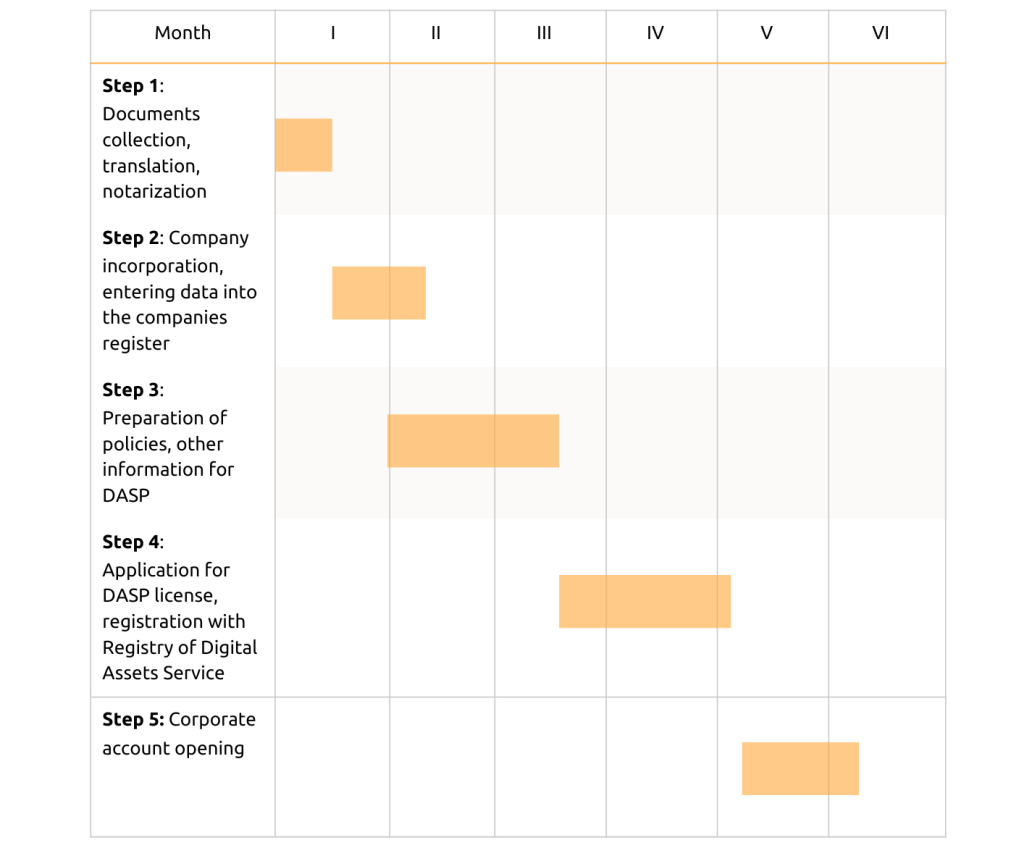
- Creation of a company in El Salvador. Register a local corporation (usually Sociedad Anónima). Prepare corporate documents (statute, consent of the board of directors) and register the company in the Commercial Register. (This can be performed by a Salvadoran lawyer or agent.)
- Preparation of documentation. Develop all necessary compliance documents, such as a detailed business plan, AML/CFT policies, KYC procedures, cybersecurity plan, internal control system, and code of ethics. Translation of documents into Spanish may be needed. Prepare a “Relevant Information Document” in which your services and team are described.
- Appointment of officials. Appoint at least two directors (foreigners are allowed), as well as a local resident legal representative and a compliance officer. Make sure that all persons who exercise control and ultimate beneficiaries have a flawless reputation.
- Submission of the application to CNAD. Submit the application (the form is available on the CNAD website) together with supporting documents. Pay the registration fee (approximately 5,475 USD for DASP). CNAD checks the completeness of the documents and may request additional clarifications.
- CNAD review (5–6 months). The regulator checks compliance with LEAD requirements and may consult with other government bodies. In case of approval, CNAD issues a certificate of registration, and the company is entered into the public register as a DASP.
- Steps after obtaining a license. After approval, open a local corporate bank account and deposit the required authorized capital. Register as an employer for tax and social security purposes, as well as with the Ministry of Labor, the Salvadoran Institute of Social Insurance, and AFP.
Throughout the entire process, local consultants often interact with CNAD on behalf of the company. By global standards, this process is considered relatively fast and inexpensive.
Maintenance and Ongoing Requirements
The presence of a crypto license implies continuous fulfillment of the following obligations:
- Annual fee. Mandatory annual DASP payment — 3,650 USD (the price list also indicates 3,476 euros per year).
- Reporting. Submission to CNAD of quarterly financial reports (at the end of January, April, July, and October), as well as any requested summaries regarding transactions. Submission to CNAD (and also to tax authorities) of annual audited financial statements. Maintenance of proper accounting, payroll reporting, and tax returns.
- Audit. Companies that reach established threshold values of assets or income must undergo an audit of financial statements with a registered Salvadoran auditor. Even if this is not mandatory, a common practice is to undergo an audit in advance to avoid comments from auditors.
- Compliance updates. Keep AML/CFT, cybersecurity, and other internal policies up to date. Any changes in key personnel or types of activities must be reported to CNAD. Licensees must have procedures for the continuous conduct of KYC and monitoring of transactions.
- Supervision. CNAD may conduct checks or request information at any time. Legal entities must cooperate with CNAD, as well as, if necessary, with other bodies (for example, the Superintendency of the Financial System).
- Taxes and legislation. Despite special benefits for cryptocurrency activities, the company must still submit all applicable tax reports in El Salvador (for example, regarding VAT on non-cryptocurrency services, or withholding tax on payments) and comply with labor legislation if it hires employees.
Failure to meet the requirements for maintaining the license may lead to warnings, fines, or suspension of the license. Therefore, licensed companies usually involve local accountants and lawyers to guarantee compliance with the requirements.
Renewal, Suspension and Revocation
The crypto license in Salvador does not terminate automatically; however, the company must renew it annually through the payment of appropriate fees and the confirmation of compliance with requirements. CNAD has the authority to suspend or cancel the DASP registration in case of violation of legislation or regulatory requirements. For example, operations without a valid license, execution of unapproved transactions with digital assets, violation of AML rules, or provision of false information can lead to the application of sanctions. The reform law also introduced direct sanctions for digital asset activities without a proper license.
If the license is suspended, the company must stop providing cryptocurrency services until the situation is resolved. In case of cancellation of registration, it is necessary to reapply for a license. In practice, CNAD usually first demands the implementation of corrective measures (expansion of internal policies, payment of fines) before resorting to license cancellation. Strict maintenance of documentation and timely submission of reporting help minimize this risk.
Regulatory Updates (2023–2026)
2023 — Adoption of the Digital Asset Law
In January 2023, El Salvador passed the Digital Asset Service Provider Regulation law. This document established the legal framework to govern digital assets and establish the National Commission for Digital Assets (CNAD). The event marked a milestone because El Salvador became one of the first Latin American nations to introduce a complete regulatory system for the cryptocurrency market.
2024 — Expansion of CNAD Powers
Parliament approved amendments to the Law of Issuance of Digital Assets (LEAD) in October 2024. These changes granted CNAD direct authority to oversee Bitcoin-related activities along with broader supervision of token issuance.
A dedicated section of the law addresses Bitcoin service providers such as custodial services, crypto exchanges, and crypto wallets. Private offerings of digital assets now fall under the regulator’s direct oversight as well.
CNAD gained the authority to set future regulatory fees independently. However, officials highlighted a key distinction: registration remains valid strictly inside El Salvador. A local license does not grant companies an automatic right to operate across international markets or claim overseas privileges.
2025 — Amendments to the Bitcoin Law
Early in 2025, the country revised its Bitcoin policy following pressure from the International Monetary Fund (IMF).
Congress modified the Bitcoin Law in January. While businesses previously had to accept Bitcoin as payment, acceptance became voluntary under the new rules.
By February 2025, lawmakers effectively repealed the law, which officially stripped Bitcoin of its legal tender status.
These policy shifts left the regulatory framework for digital asset service providers (DASPs) untouched. Instead, the updates reflect how state cryptocurrency policy has evolved. The Law of Issuance of Digital Assets remains active for all other tokens and digital assets.
Recent developments demonstrate that El Salvador’s regulatory environment for crypto assets continues to mature. After the initial Bitcoin Law, the government formed CNAD, an agency that publishes official guidance and expands international cooperation today.
The Memorandum of Understanding signed with Bolivian regulators in 2025 highlights this momentum. Entities registered as DASPs under CNAD supervision must track new anti-money laundering and counter-terrorism financing (AML/CFT) rules alongside updated technical standards.
Why El Salvador Attracts Cryptocurrency Business
El Salvador presents distinct advantages for fintech startups and digital asset firms.
Regulatory certainty and pioneer advantage. The nation became an early adopter of a clear licensing system for cryptocurrency ventures. Clear operational rules allow companies to gain media attention and connect with investors and partners more easily.
Practically zero tax burden. Licensed digital asset activities benefit from a highly favorable tax structure. Businesses can lower operating expenses and boost profitability as a direct result.
Dollarized economy. Standard international transactions run smoothly because the US dollar serves as the official currency. Companies avoid local exchange rate risks, which offers foreign investors a more stable financial environment.
Innovative ecosystem. Public authorities actively support sector growth. Key initiatives include the BVES digital asset exchange and strategic alliances with blockchain firms like Tether. Furthermore, CNAD maintains a public register of issuers and service providers to boost market transparency and foster participant trust.
Low barriers to market entry. Corporate registration in El Salvador involves simple procedures. The law omits heavy capital requirements, permits non-resident executives, and allows virtual office addresses. Employers face no mandate to hire local staff, which keeps administrative overhead low.
Gateway to the Latin American market. An El Salvador license offers a strong springboard into neighboring markets. Central American remittance and tourism sectors move nearly $7 billion USD every year and continuously adopt crypto options. El Salvador’s early momentum gives businesses expanded opportunities to launch pilot projects and scale regional partnerships.
Prospective market entrants must balance these benefits against notable challenges. Key hurdles include a modest domestic market size and a regulatory framework that undergoes ongoing revisions.
FAQs About a Crypto License in El Salvador
What is the difference between a DASP license and a Bitcoin Service Provider (BSP) registration in El Salvador?
El Salvador operates under a dual-layer regulatory framework. The DASP license, overseen by the National Commission of Digital Assets (CNAD) under the Law of Issuance of Digital Assets, is required for firms handling non-Bitcoin digital assets. Conversely, any entity providing services exclusively or primarily for Bitcoin transactions must register separately as a Bitcoin Service Provider (BSP) to comply with the country’s specific Bitcoin regulatory requirements.
What are the primary operational requirements to obtain a DASP license in El Salvador?
To successfully register as a DASP with the CNAD, firms must satisfy several key substance and personnel requirements, including:
- Incorporation of a local legal entity in El Salvador.
- Appointment of at least two directors and two founders (non-residents are permitted).
- Appointment of a locally based, certified Head of Compliance and a Deputy Head of Compliance.
- Appointment of a locally resident Computer Security Officer.
- Establishment of a registered office (virtual address is accepted).
What are the financial obligations and tax incentives for licensed crypto firms in El Salvador?
Licensed entities benefit from a highly favorable fiscal environment, featuring a 0% corporate income tax on digital asset business income and a 0% VAT rate on crypto transactions. Initial costs include a minimum charter capital of USD 2,000, a government registration fee of USD 5,475, and a EUR 250 transaction fee. Additionally, firms must pay a mandatory annual DASP maintenance fee to the CNAD.
How long does the licensing process take, and what are the ongoing compliance duties for firms in El Salvador?
The application process typically spans 5–6 months, during which the CNAD reviews the firm’s AML/CFT policies, cybersecurity protocols, and business models. Once licensed, firms must maintain continuous compliance by filing mandatory quarterly financial reports, submitting annual audited financial statements, and keeping all risk management and security documentation updated to align with evolving national regulatory standards.
Official Sources & Primary Legislation (El Salvador)
Primary Acts
- Ley de Emisión de Activos Digitales (DL 643) – full text (Spanish, CNAD legal library)
- Digital Assets Issuance Law – non-official English translation (CNAD)
- Reglamento de Proveedores de Servicios de Activos Digitales (2023) – DASP regulation (Spanish, downloads page)
- Reglamento de Emisión de Ofertas Públicas de Monedas Estables (2023) – Stablecoins public offering regulation (Spanish)
- Reglamento de Registro de Emisores y Emisiones Públicas y Privadas – Issuers & Issuances Registry regulation (Spanish)
- Ley Bitcoin (Decreto Legislativo n.º 57, 2021) – archival full text (Spanish, Diario Oficial)
- Decreto Legislativo n.º 199 (29 Jan 2025) – Bitcoin Law reform (removes mandatory legal-tender acceptance; Spanish)
National Commission of Digital Assets (CNAD)
- Official CNAD website – regulator and licensing portal
- Legal Framework library – consolidated links to the law & regulations
- Register as a Digital Assets Service Provider (PSAD/DASP) – application process & requirements
- Digital Assets Service Providers – Public Registry – official list of registered DASPs
- Issuers – Public Registry – entities authorized as issuers
- Issuances – Public Registry – authorized public/private offerings
- Certifiers – Public Registry – accredited certifying entities
- Downloads – forms & procedural guidance (e.g., PSAD registration procedure)
- Transparency Portal – Normative Framework – official list of laws, regulations & guides
Jurisdictions


Crypto Licenses


Get in touch with us

Daria Lysenko
Senior lawyer

Valeriia Kozel
Customer manager
You can be interested in following articles
MiCA License Deadline Has Passed: What Crypto Companies Without a CASP License Can Do Now (2026)
What ESMA’s Statement Means for Crypto Companies in Europe: Practical Tips for Compliance
Crypto License in Latin America (2026): A Practical Guide for Launching in El Salvador, Brazil, Argentina & Panama
SRO License in Switzerland (2026): Requirements, Costs and How to Obtain
How Much Does a Gambling License Cost in 2026?
Why Operators are Turning to Liberia for iGaming Licensing: A Competitive Alternative to Curacao
MiCA Regulation: New Rules and Outlook for 2026
US Crypto Regulations

The Beginner’s Guide to Online Gambling Licences: Everything You Need to Know
Top 5 Crypto-Friendly Jurisdictions for 2025-2026: Expert Guide by SBSB FinTech Lawyers
Seychelles vs Mauritius Forex Licenses: Costs, Benefits, and Licensing Process
Sweden Amends Gambling Act to Crack Down on Unlicensed Operators
Customer reviews