
- Kahnawake Gambling License Factsheet
- Benefits of the Kahnawake Gaming License
- Kahnawake Gambling Licence Main Points
- B2B Options
- B2C Options
- Other Licensing Options
- Types of Gameplay Covered
- Kahnawake Gambling License Cost
- The Application Process
- Maintaining the validity of the license
- The Kahnawake Gaming Commission
- Kahnawake licence in 2026: updates and trends
- Turnkey Implementation
- Payments Setup
- Licensing Support
- What the Turnkey Package Includes
- Official Sources & Primary Legislation (Kahnawake)
Licenses for online casinos,
betting, skillgaming, lotteries etc.
Full-support for gaming projects
Kahnawà:ke is a territory of the Mohawk people, located not far from Montreal. In 2024, about 11,200 residents lived here. Despite its small size, this jurisdiction has become one of the most authoritative centers of online gambling in the world.
Since 1999, the Kahnawake Gaming Commission (KGC) has been issuing licenses to iGaming operators. One of the main conditions is the placement of servers in the data centers of Mohawk Internet Technologies (MIT).
One of the key advantages of the jurisdiction is a favorable tax system. Licensees do not pay tax on gambling income, and are also exempt from corporate tax and capital gains tax.
The cost of licensing remains moderate:
- Registration of a CPA license — 40,000 USD (including the first year of validity).
- Annual renewal — 20,000 USD.
- Key Person Permit — 1,000 USD.
Online gambling has become an important source of income for the local community. In the period from 2015 to 2023, Mohawk Online Limited received over 39 million USD, of which 23 million USD was paid out in the form of dividends to the Mohawk Council of Kahnawà:ke. More than 5.5 million USD more was directed to the development of the community, in particular for the construction of a cultural center. Although income decreased after the change of rules in Ontario in 2023, this example demonstrates how even a small territory can successfully use iGaming to finance social projects.
Kahnawake Gambling License Factsheet
Below is a table with up-to-date data on key parameters of the gambling license in Kahnawake (Client Provider Authorization – CPA), including processing time, fees, and requirements (as stated in the provided document):
| Parameter | Value |
|---|---|
| License processing time | Up to 6 months (turnkey implementation timeline); initial 6-month trial licence before 5-year grant upon compliance |
| Application fee | CPA (B2C): USD 40,000 total — covers Commission due diligence of company, executives and Key Person; includes first annual licence fee of USD 20,000 (refundable if application is not granted); obtaining Key Person Permit included |
| Annual renewal fee | CPA (B2C): USD 20,000 per year + Key Person Permit renewal USD 1,000 per person |
| Minimum capital requirement | Not specified by KGC; depends on the jurisdiction of company incorporation (authorized capital/audit/reporting per incorporation rules) |
| Tax on profit | 0% gaming tax (but depends on the jurisdiction and registration of the company) |
| Resident representative | No local residency requirement for directors/shareholders; at least one Key Person (can be the director) is required |
| Office requirement | No physical office requirement |
| Server location requirement | Yes — local hosting in Kahnawake; connections to a local data center and public cloud |
| Number of domains | Not specified in this document |
| Markets | Global “.com” markets (international); USA restricted |
| Restricted countries | USA and FATF list: Algeria; Angola; Bolivia; Bulgaria; Burkina Faso; Cameroon; Côte d’Ivoire; Democratic Republic of the Congo; Haiti; Kenya; Lao PDR; Lebanon; Monaco; Mozambique; Namibia; Nepal; Nigeria; South Africa; South Sudan; Syria; Venezuela; Vietnam; Virgin Islands (UK); Yemen. (Croatia, Mali, and Tanzania were removed in June 2025.) |
| AML/KYC requirements | Mandatory due diligence/KYC; ongoing submission of compliance information to KGC; responsible gambling & underage gambling policies; meetings with the Commission as required |
| Typical hosting costs (indicative) | Local hosting approx. USD 3,770 per month; connection fee USD 250 |
Benefits of the Kahnawake Gaming License
Relatively quick licensing process
The full process to obtain a gambling license in Kahnawake usually takes up to 6 months. Initially, the KGC issues a temporary license for a six-month term. If the operator complies with all regulatory requirements during this period, they receive a full five-year license.
Straightforward Requirements
Founders, shareholders, and directors must meet the following criteria:
- Key Person. The company must appoint at least one Key Person (most often a director). This individual must obtain a separate Key Person Permit from the KGC.
- Technical Requirements. All games must undergo certification (RNG, RTP, or developer confirmation). Some or all servers must reside in Mohawk Internet Technologies data centers. This means local hosting in Kahnawà:ke is mandatory.
- Website and Operations. The application requires a completed website with a description of future operations. Applicants must also provide proof of domain registration, a list of games, and corresponding certificates.
- Required Documents. For individuals:
- Bank reference letter.
- Resume (CV).
- Remote identity verification.
- Declaration of source of funds.
For companies:
- Notarized corporate documents and registers (with an apostille).
- Documents regarding Ultimate Beneficial Owners (UBOs) and directors.
Strong Player Acceptance
The jurisdiction highlights a reliable regulator, high reputation with partners and customers, and the ability to open accounts in European payment institutions. Over 250 online casinos operated by about 50 operators use the Kahnawake licence.
Suitable for Startups and Small Operators
Minimum staffing is permitted (at least one employee – the director as Key Person), there is no physical office requirement, and there are no nationality or residency requirements for directors. The up-to-6-month roadmap helps lean teams launch efficiently.
Tax Advantages
Companies that operate under a Kahnawake gaming license pay no tax on gaming income. At the same time, the country of incorporation determines corporate taxation, audits, and financial reporting, rather than the KGC regulator.
Why the Kahnawake online gambling license is ideal for startups
Several major benefits make this jurisdiction attractive to new operators:
- Operators receive a full Kahnawake gaming license directly from the regulator instead of a sublicense.
- The framework allows operations in international markets.
- The Canadian jurisdiction carries high prestige.
- Staffing requirements remain minimal, and there is no need to open a local office.
- The geographic reach is broad. The United States is the only explicitly prohibited market.
Kahnawake Gambling Licence Main Points
The KGC issues two main categories of licenses: Interactive Gaming (online) and Land-Based. We focus on the interactive side, which covers a full range of online gambling. Licenses are structured to support both B2B and B2C operators:
B2B Options
- Interactive Gaming Licence (IGL): This is the exclusive hosting license (only one IGL, held by Mohawk Internet Technologies, exists) that provides server infrastructure in Kahnawake. IGL enables the territory’s data centers to offer hosting to licensees.
- Casino Software Provider Authorizations (CSPA): Permits companies to supply casino and gambling software to licensees. A CSPA holder can operate gaming platforms and even sub-licence game content to other online operators. Essentially, CSPA firms are B2B providers of gaming technology and services.
B2C Options
- Client Provider Authorisation (CPA): The most common license for operators. CPA holders run online casinos, poker rooms, sportsbooks, or lotteries. They must operate from the Kahnawake-hosted servers under the IGL. There is no cap on CPAs issued; numerous operators can obtain CPAs to serve players worldwide (except the USA).
- Live Dealer Studio Authorisation (LDSA): For companies running a live-dealer studio within Kahnawake. LDSA holders manage professional live table games (e.g. blackjack, roulette with real dealers) streamed to online casinos. It allows conducting and servicing live games in the territory.
Other Licensing Options
- Key Person Licence/Permit (KPL/KPP): This is actually issued to individuals, not companies. Any company (CPA or CSPA) must have at least one “Key Person” with a KPL. This person holds a managerial or operational role and must be licensed by the KGC. Obtaining a KPL for the designated person is the first step for any applicant company.
- Interjurisdictional Authorisation (IJA): A special permit for companies already licensed elsewhere (with their own IGL) that wish to bring equipment or staff to Kahnawake. It allows cross-jurisdictional hosting arrangements without re-licensing entire operations.
Types of Gameplay Covered
Kahnawake gaming licenses cover virtually every form of gambling:
- Online casinos: all typical casino games (slots, table games, video poker, etc.) are permitted. Licensed operators must use certified RNGs and ensure game fairness. Licensed online casinos provide regulated virtual gaming experiences under strict KGC oversight.
- Sports betting platforms: operators can offer sports wagering under Kahnawake regulation. The license involves effective risk controls and fraud prevention are in place for sportsbooks. Bettors on KGC-licensed sites benefit from the same high standards and legal protections as casino gamers.
- Live dealer casinos: the LDSA license allows real-time casino games via live video. Licensed live-dealer studios furnish games (with professional dealers) to online casino brands. These games are subject to KGC rules on fairness and transparency.
- Land-based casinos: even brick-and-mortar casinos are covered. Kahnawake issues land-based licenses (for example, slot machine facilities) under separate land-based regulations. Such venues are licensed to operate standard casino games in physical premises, monitored by the KGC.
- Land-based poker rooms: the territory also has licenses for live poker rooms. Licensed poker rooms (often in social or community settings) must adhere to KGC standards on fairness and AML, even though they are land-based venues.
Kahnawake Gambling License Cost
Application Fees
Kahnawake uses a single CPA (operator) application fee of USD 40,000 that covers: the Commission’s due diligence on the company, executives and the Key Person (non-refundable), the first annual license fee of USD 20,000 (refunded if the application is not granted), and obtaining the Key Person Permit as part of the application package.
- CPA (B2C): USD 40,000 total — includes due diligence, first-year license fee (20,000 is refundable if not granted), and obtaining a Key Person Permit.
Renewal Fees
After the first year:
- CPA: USD 20,000 per year
- Key Person Permit (KPL): USD 1,000 per person (annual renewal)
Additional Expenses
Beyond the Kahnawake gaming license cost, applicants should consider associated expenses.
- Hosting: server placement at Mohawk Internet Technologies or Continent8 costs approximately 3,770 USD per month. The one-time setup fee is 250 USD.
- Legal support: turnkey application preparation and submission costs around 15,150 EUR. Annual legal support during license renewal and KYC updates requires approximately 5,175 EUR.
- Other expenses: this category includes document translations, travel expenses, postage costs, VAT (if applicable), courier services (about 100 EUR), bank fees (about 45 EUR), and integration of banking services if needed.
The Application Process
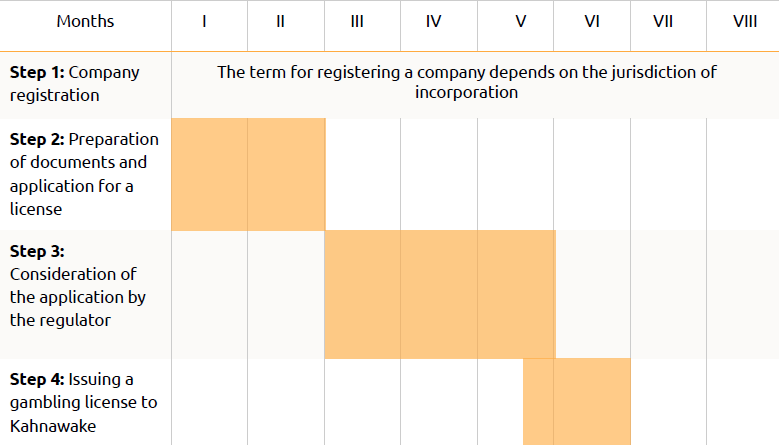
Stages of obtaining a Kahnawake online gambling license
On average, the procedure for obtaining a gambling license in Kahnawake lasts up to six months and consists of several successive stages.
Step 1. Company registration
First of all, it is necessary to register a legal entity in the chosen jurisdiction. Most often, Canada or one of the offshore jurisdictions is chosen for this. After registration, the corporate structure is formed: directors and shareholders are appointed, and also all necessary corporate documents are prepared.
Step 2. Document preparation
At this stage, the applicant collects a full package of documents. It includes a business plan, proof of origin of funds, corporate documents, information about directors and key persons, gaming software certificates, as well as proof of domain ownership.
At the same time, it is necessary to ensure that the website complies with the requirements of the regulator. In particular, it must display the terms of use, the players’ self-exclusion policy (Self-Exclusion Policy), the KGC logo, and other mandatory elements.
Step 3. Application review
After submitting the documents, the Kahnawake Gaming Commission (KGC) appoints a compliance specialist (Compliance Officer) who checks the application. Usually, this process takes from four to eight weeks.
During the check, the following are evaluated:
- business reputation of the company owners;
- sources of origin of funds;
- technical infrastructure of the platform;
- compliance with all regulatory requirements.
If the commission needs additional information, the applicant will receive a corresponding request. In case of a positive decision, the procedure moves to the next stage. If the KGC refuses to issue the license, the paid registration fee is returned.
Step 4. Obtaining the Kahnawake online gambling license
After approval of the application, the KGC issues a temporary license for a period of six months. During this period, the operator must confirm full compliance with all requirements of the regulator.
For this, it is necessary to:
- place the official KGC logo on the website;
- publish the license certificate;
- undergo an independent audit of control systems (Schedule I) conducted by an accredited auditor.
After successful completion of the audit and completion of the final check, the operator receives a full Kahnawake online gambling license for a period of five years.
Since the procedure involves the preparation of a large volume of documentation, most companies involve specialized legal consultants. This helps to avoid mistakes, speed up the review of the application, and reduce the risk of delays.
Maintaining the validity of the license
Obtaining a Kahnawake online gambling license is only the beginning. To maintain its validity, the operator must constantly fulfill the requirements of the KGC.
Every year it is necessary to:
- update corporate and financial information;
- pay the annual license fee;
- renew Key Person Permits for key persons of the company.
For example, renewal of the CPA license costs 20,000 US dollars, and renewal of one Key Person Permit is another 1,000 US dollars.
Many operators entrust these procedures to legal companies. Such firms prepare documents for license renewal, support KYC procedures, and interact with the regulator. The cost of such support averages about 5,175 euros per year.
In addition, the operator is obliged to constantly:
- maintain the official KGC logo on the website;
- ensure the operation of the player self-exclusion system;
- use only certified software;
- regularly undergo technical audits.
Failure to comply with the requirements regarding fair play, anti-money laundering (AML) rules, or other regulatory norms can lead to temporary suspension of the license or its full revocation.
Thus, maintaining the license is not only the annual payment of fees. It is a continuous process of documentation control, technical compliance, and fulfillment of all requirements of the regulator.
The Kahnawake Gaming Commission
Role and authority
The Kahnawake Gaming Commission (KGC) is a sovereign regulator of gaming activity on the territory of the Mohawk people of Kahnawake. It operates in accordance with Kahnawake law, which is based on the recognition of indigenous rights in the Constitution Act of Canada of 1982.
The Commission has the right to issue, suspend and revoke licenses for both online and land-based gambling operators. Today, over 50 licensees work under its supervision, managing approximately 250 gaming sites around the world. Thanks to this, KGC is one of the most authoritative regulators in the iGaming sphere.
The regulator is known for its transparent approach and high standards of control, the main goal of which is to ensure the honesty of operators’ work and protect players.
To verify compliance with technical requirements, the Commission cooperates with accredited auditors (Approved Agents), who conduct independent audits and testing of platforms. In addition, KGC interacts with other international regulators. For example, in 2016 the Commission stopped licensing operators focused on the US market.
In general, KGC is responsible for the full cycle of regulation of gaming activity — from the issuance of licenses and control over compliance with rules to the consideration of disputes between operators and players.
Kahnawake gaming regulations
The legal framework of Kahnawake is formed on the basis of the Kahnawake Gaming Law of 1996 and the Interactive Gaming Regulations of 1999.
These documents define all requirements for companies that receive or already have a license. In particular, they regulate:
- conditions for obtaining a license;
- technical standards (in particular the use of certified random number generators — RNG);
- mandatory self-limitation tools for players;
- anti-money laundering (AML) requirements;
- the procedure for conducting audits and applying sanctions.
Licensees are required to monitor age restrictions, prevent the participation of persons who do not meet the requirements, as well as ensure timely payment of winnings and proper consideration of player appeals.
Every year, operators must confirm compliance with the regulator’s requirements by submitting reports and undergoing independent audits. In case of violations, the Commission can apply disciplinary measures up to the revocation of the license.
Although KGC regularly updates individual rules in accordance with the development of technologies, its regulatory model remains stable and predictable, maintaining the main priority — a safe and fair gaming market.
Kahnawake licence in 2026: updates and trends
In recent years, the Commission modernized individual processes and revised the size of fees without changing the basic principles of licensing.
Main updates in 2023–2026:
- Official website update. In October 2023, KGC launched a new official website, making information about licensing and regulatory requirements more accessible.
- Fee increase. At the end of 2023, licensing payments were increased by approximately 14%. In particular, the cost of submitting a CPA application increased, however, the jurisdiction of Kahnawake continues to remain competitive in cost.
- Procedure stability. Despite the update of tariffs, the process of obtaining a license itself and the list of requirements practically did not change. Clear rules and a transparent payment structure provide business with predictability and confidence during project launch planning.
According to industry experts, thanks to stable regulation and the absence of corporate taxation, Kahnawake remains one of the most attractive jurisdictions for online gambling operators in 2026.
Interest in the KGC license continues to grow: new online casinos and betting companies regularly choose this jurisdiction, using its international reputation and established cooperation with accredited auditors, payment providers and other industry participants.
Turnkey Implementation
Company Creation and Corporate Structure
The provider incorporates a company in a jurisdiction selected individually for the project and client, and builds a lean corporate structure that meets Kahnawake’s key requirements. The offer allows a minimum structure of one shareholder and one director with no nationality or residency requirements for directors, and a minimum staffing level of one employee (the director acting as the Key Person). A Key Person Permit from the Kahnawake Gaming Commission is mandatory. There is also no physical office requirement in this proposal.
Payments Setup
The solution is positioned to help open accounts with European payment institutions and to work comprehensively with fiat and crypto. Optional integration services include connecting a corporate account and connecting a merchant account.
Licensing Support
End-to-end legal support covers the entire application cycle: collection and verification of documents, preparation of all forms and UBO declarations, website checks for regulatory compliance, submission of compliance information and due-diligence with KYC fees, meetings and ongoing feedback with the Kahnawake Gaming Commission, assistance in obtaining the Key Person Permit, drafting the business plan and required policies (Terms & Conditions, Underage Gambling, Responsible Gambling). A project road map is provided with a turnkey timeline of up to 6 months.
What the Turnkey Package Includes
Comprehensive legal support for obtaining a Kahnawake license, which includes:
- collection, verification and preparation of all necessary documents;
- preparation of a full package of materials for licensing;
- analysis of website compliance with regulatory requirements;
- submission of documents and payment of fees for compliance, due diligence and KYC;
- preparation of all forms, UBO (ultimate beneficial owner) declarations and other mandatory documentation;
- support of meetings with KGC representatives;
- assistance in obtaining a Key Person Permit;
- processing of regulator’s comments;
- preparation or refinement of a business plan;
- development of mandatory Terms & Conditions and responsible gaming policy.
The package also provides full project management according to a step-by-step plan — from the start of document preparation to obtaining a license. Estimated implementation period — up to 6 months.
If necessary, additional services can be provided:
- company registration;
- opening a corporate bank account and connecting a merchant account;
- preparation of additional policies for the site (Privacy Policy, Cookie Policy, AML/KYC Policy, Refund Policy);
- development of an individual client agreement;
- nominee service;
- search for candidates for key positions and office space;
- software selection;
- assistance with confirmation of the source of funds origin;
- creation of a payment agent company.
Please note: official regulatory fees and hosting expenses remain separate from the turnkey package price.
| Expense item | Cost (USD) | Frequency |
|---|---|---|
| KGC Fee (CPA submission, first-year license, Key Person Permit) | $40,000 | One-time / initial |
| Continent8 Hosting | $3,770 (approx.) | Monthly |
| Connection Fee | $250 | One-time |
Official Sources & Primary Legislation (Kahnawake)
Primary Acts
- Kahnawà:ke Gaming Law – full text (Mohawk Council of Kahnawà:ke)
Kahnawà:ke Gaming Commission (KGC)
- Official KGC website – regulator and licensing portal
- Interactive Gaming Regulations (overview) – framework for online/interactive gaming
- Regulations concerning Interactive Gaming (PDF, Dec 2, 2024) – latest consolidated version
- Regulations concerning Anti-Money Laundering & Counter-Terrorism Financing (PDF) – AML/CFT obligations
- Regulations concerning Poker Rooms (PDF) – land-based poker oversight
- Regulations concerning Electronic Gaming Devices (PDF, Jan 8, 2025) – land-based EGDs
- Application process & forms – CPA/KPL schedules and how to apply
- Interactive Gaming Permit Holders – public register of certified operators/URLs
- Approved Agents – testing/audit and due-diligence providers appointed by KGC
FAQ
What is the Kahnawake Gaming Commission (KGC) license?
The Kahnawake gambling license is an official authorization issued by the Kahnawake Gaming Commission (KGC). It enables operators to legally conduct online gaming activities, including online casinos, poker rooms, and sportsbooks. Established in 1999, the KGC is one of the world’s most established and reputable regulators, providing a recognized standard of trust for players and B2B partners alike.
What are the main benefits of this license?
Key advantages include:
- Global Reputation: The KGC license is highly respected internationally, which simplifies the process of opening accounts with European payment institutions and banks.
- Favorable Tax Regime: There is 0% tax on gaming revenue, and the jurisdiction does not impose corporate or capital gains taxes (subject to the operator’s company incorporation jurisdiction).
- Versatility: The license supports both B2C operators (e.g., online casinos) and B2B providers (e.g., software developers).
- Operational Flexibility: There is no requirement for a physical office in Kahnawake or local residency for directors. Only one “Key Person” with a permit from the commission is required.
What is the process, and what are the associated costs?
The licensing process (Client Provider Authorisation — CPA) typically takes up to 6 months. The commission initially issues a 6-month provisional trial license, which is upgraded to a 5-year license upon successful compliance.
- Application Fee: $40,000 USD (includes due diligence and the first-year license fee).
- Annual Renewal: $20,000 USD per year.
- Hosting: Additional costs apply for mandatory local hosting on Mohawk Internet Technologies servers.
What are the technical requirements for operators?
Licensees must adhere to strict technical and operational standards, including:
- Local Hosting: All gaming servers must be hosted in designated data centers within the Kahnawake territory.
- Game Certification: All games must be certified for fairness (RNG/RTP) or licensed through approved developer agreements.
- Compliance: Operators are required to maintain robust Anti-Money Laundering (AML), Know Your Customer (KYC), and Responsible Gambling policies.
What markets can I operate in?
The Kahnawake license grants access to international “.com” markets. However, licensees are required to use geo-blocking tools to restrict access from prohibited jurisdictions, which currently include the USA and certain countries on the FATF list.
Get in touch with us

Roman Baranovskyi
Senior lawyer

Valeriia Kozel
Customer manager
Customer reviews